Pitot tube pumps can be evaluated as an alternative solution for selected high pressure low flow applications where traditional multistage centrifugal pumps may present maintenance, complexity, or operating challenges.
Request Engineering Review Submit Pump Data
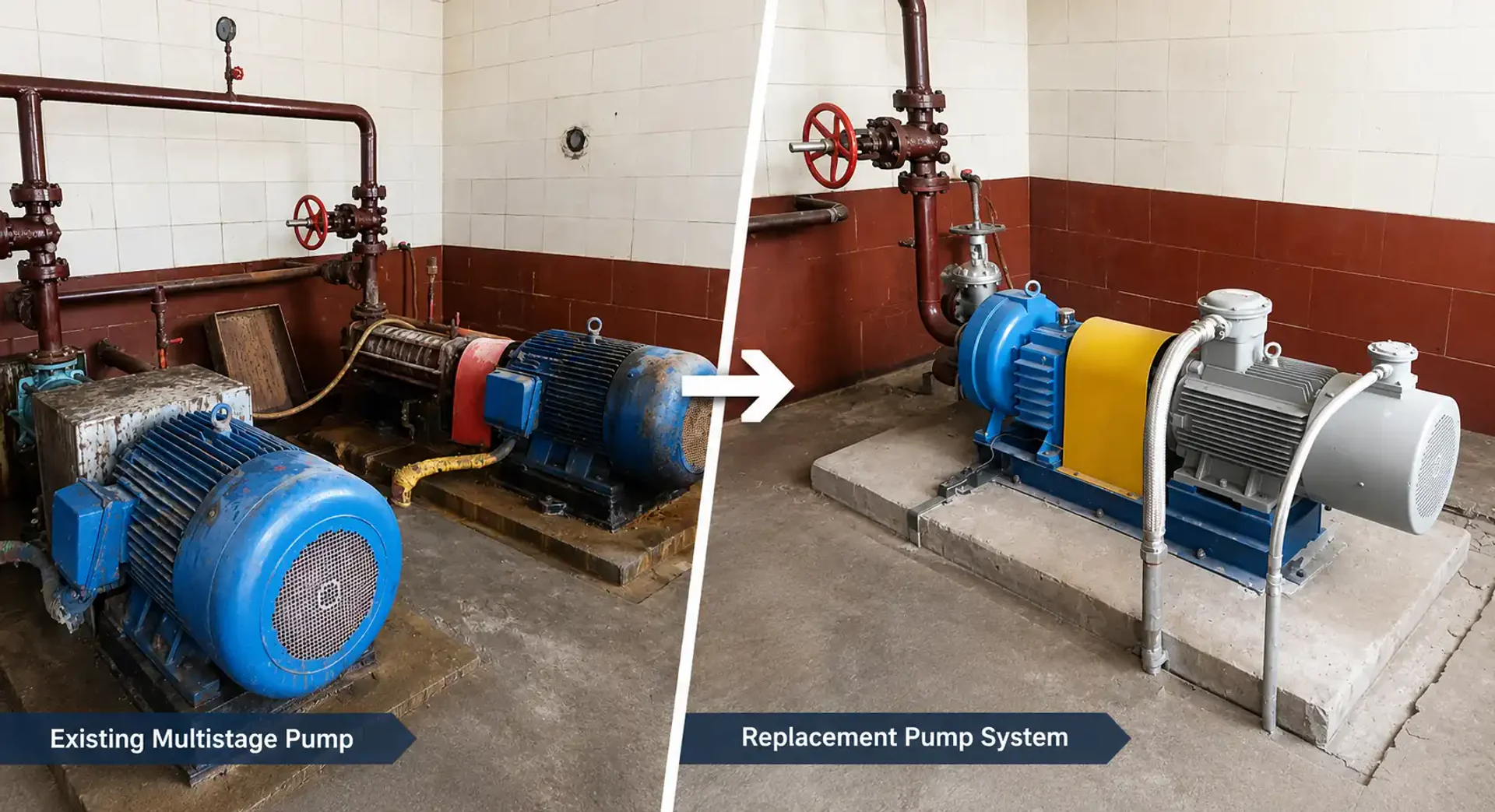
Multistage pumps are widely used for high pressure service and can be appropriate for many applications. A replacement evaluation may be useful when the operating point, maintenance history, or process conditions suggest that another pump technology should be reviewed.
Multiple hydraulic stages can require careful review when internal wear, clearances, or performance changes affect operation.
Maintenance frequency, parts availability, and repair scope may justify reviewing an alternative configuration.
Low flow operation can require careful evaluation to confirm stability, control, and pump suitability.
High pressure duty should be reviewed with flow, suction conditions, materials, and operating limits.
Engineering review helps determine whether a pitot tube pump alternative is suitable for the actual duty point.
Review the detailed Pitot Tube Pump vs Multistage Pump comparison when evaluating hydraulic principles, maintenance considerations, and application fit.
A pitot tube pump uses velocity energy recovery through a stationary pitot tube, while a multistage pump builds pressure through multiple impeller stages.
Both technologies must be selected against the required duty point. Pitot tube pumps are commonly reviewed for high pressure low flow pump applications.
Multistage pumps use multiple staged hydraulic components. Pitot tube pump construction follows a different hydraulic arrangement that may simplify selected duties.
Maintenance comparison should consider fluid properties, wear risk, seals, operating cycle, and parts support for the installed equipment.
Low flow high head pump service should be evaluated for stability, control range, hydraulic fit, and process requirements.
Final selection depends on pressure, flow, fluid, temperature, viscosity, suction conditions, materials, and site standards.
A pitot tube pump alternative may be suitable for selected high pressure low flow applications, low flow high head duty, and industrial process applications where the duty point and fluid properties align with the pump configuration.
Difficult liquid conditions such as viscosity, entrained gas, contamination, or material compatibility concerns should be reviewed before recommending any industrial pump replacement.
Collect model number, nameplate data, pump curve, drawings, materials, seal details, and maintenance history.
Confirm flow rate, pressure or head, suction conditions, operating range, and process control requirements.
Check fluid type, temperature, viscosity, vapor pressure, solids, gas content, and corrosion risk.
Review materials, mechanical seals, elastomers, and project standards for the application.
Summarize whether a pitot tube pump alternative should be considered for quotation or further technical review.
Brand, model, curve, nameplate data, and drawings when available.
Normal, minimum, and maximum flow requirements.
Required discharge pressure, total head, and suction conditions.
Fluid name, chemistry, and compatibility notes.
Normal and maximum operating temperature.
Viscosity at operating temperature when known.
Entrained gas, solids, slurry, or contamination details.
Duty cycle, control mode, installation limits, and current operating problems.
Selected high-pressure, relatively low-flow duties may merit review when operating range, maintenance, process changes, or difficult fluid conditions affect the existing arrangement. Suitability depends on complete hydraulic and process data.
No. The review also needs suction pressure, available NPSH information, full operating range, system behavior, fluid properties, temperature, materials, seals, and driver requirements.
Provide minimum, normal, maximum, startup, and any transient duties together with the control method. Engineering should confirm that the proposed pump and system can operate across the required range.
Useful records include the current model and curve, motor and speed, nozzle arrangement, base and coupling dimensions, seal plan, controls, and maintenance history. These details help identify whether piping, foundation, or driver changes may be required.
Send your current pump data, duty point, fluid properties, material requirements, and operating concerns for engineering review.