Pitot tube pumps are engineered for high pressure, low flow, and high head industrial applications where stable operation and careful pump selection are required.
Request a Quote Request Technical Datasheet

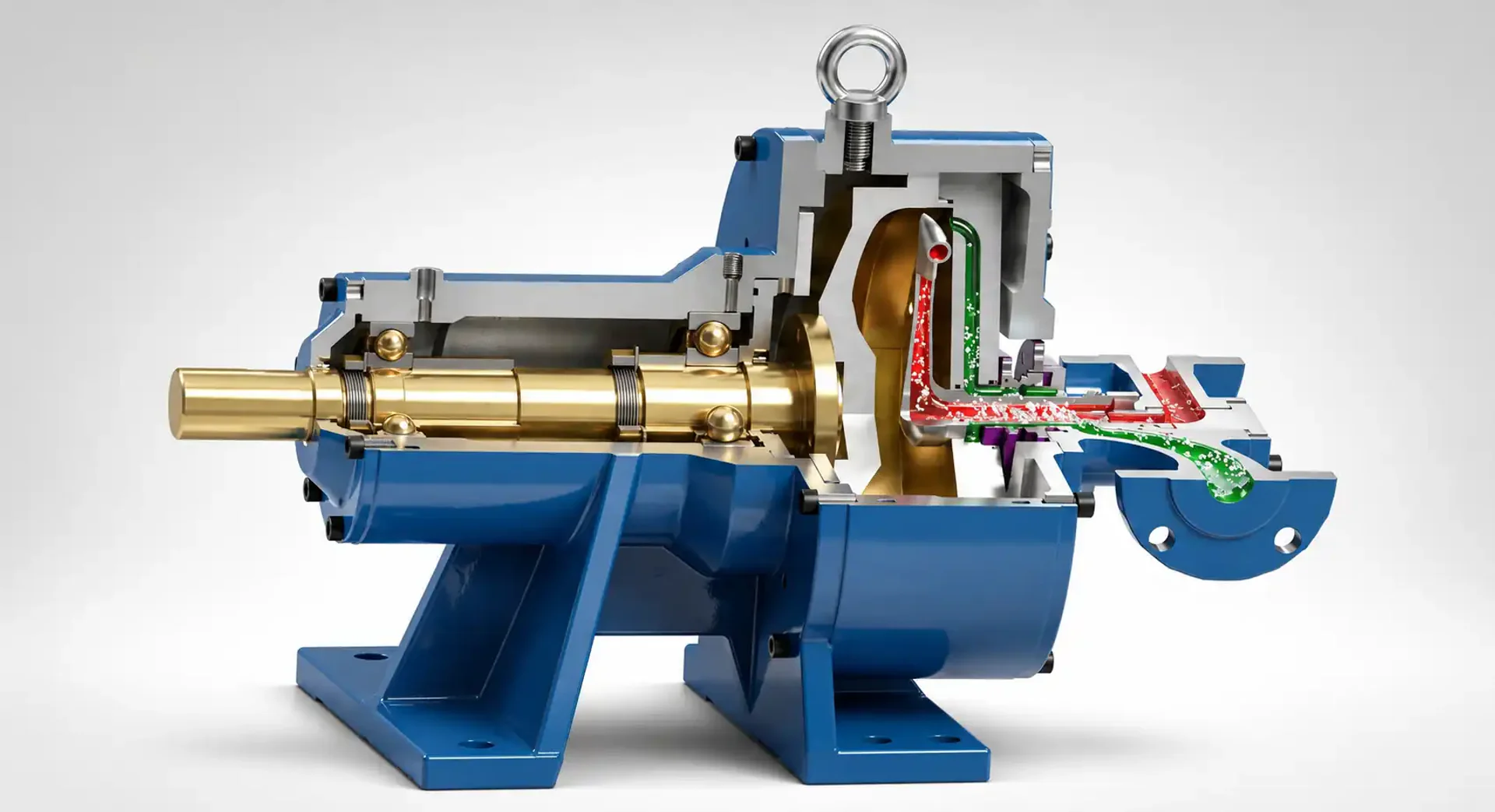
A pitot tube pump is a specialized pump based on centrifugal pump technology. The detailed pitot tube pump working principle uses a rotating casing and a stationary pitot tube to convert velocity energy into discharge pressure instead of using multiple impeller stages to build pressure.
Fluid rotates inside the casing, gains velocity, and is collected by the pitot tube. This velocity energy conversion creates pressure generation suitable for selected high pressure low flow pump applications.
Process liquid enters the rotating casing and begins moving with the casing wall.
Rotational motion increases fluid velocity and stores energy in the moving liquid.
The stationary pitot tube captures the high velocity liquid from the rotating casing.
The captured velocity energy is converted into discharge pressure for the process.
Pitot tube pumps are commonly evaluated for low flow high head duty in industrial process applications. They may be considered where difficult liquid conditions, process stability, or replacement evaluation make conventional pump selection more complex.
As an industrial high pressure pump option, final suitability depends on the actual duty point, fluid properties, suction conditions, material requirements, and operating environment.
0.22 - 308 GPM
Up to 3280 ft
Up to 500°F
Application dependent
Published values are for preliminary review only. Actual performance depends on pump configuration, fluid properties, materials, and specific operating conditions.
Material choices should be reviewed against corrosion risk, temperature, fluid chemistry, and site standards.
Seal selection depends on pressure, temperature, fluid properties, duty cycle, and process safety requirements.
OEM and project applications may require specific documentation, dimensions, testing, and connection requirements.
Industrial pump configuration should be matched to the actual duty point and installation conditions.
Application data can be reviewed before final pump selection and quotation.
Duty point, fluid data, materials, and seal requirements can be evaluated for the process.
Existing applications can be reviewed through a multistage pump replacement evaluation or a Roto-Jet replacement review.
Selection support is focused on industrial process conditions and high pressure low flow service.
The hydraulic assembly includes a rotating casing, a stationary pitot tube, and passages that collect and discharge the liquid. Their combined action accelerates the liquid and recovers velocity energy as pressure.
Evaluation is most relevant to selected industrial duties with relatively low flow and high pressure or head. The complete operating range, suction conditions, and fluid behavior must still be checked for the application.
Selection requires minimum, normal, and maximum flow where available, pressure or head, suction conditions, fluid composition, temperature, viscosity, specific gravity, gas or solids content, and operating schedule.
These items are reviewed against the fluid, temperature, pressure, site standards, and mechanical arrangement. For replacement work, provide the existing pump model, curve, motor data, nozzle details, base dimensions, and operating history when available.
Send your flow rate, pressure or head, fluid properties, temperature, viscosity, and current pump details for engineering review.